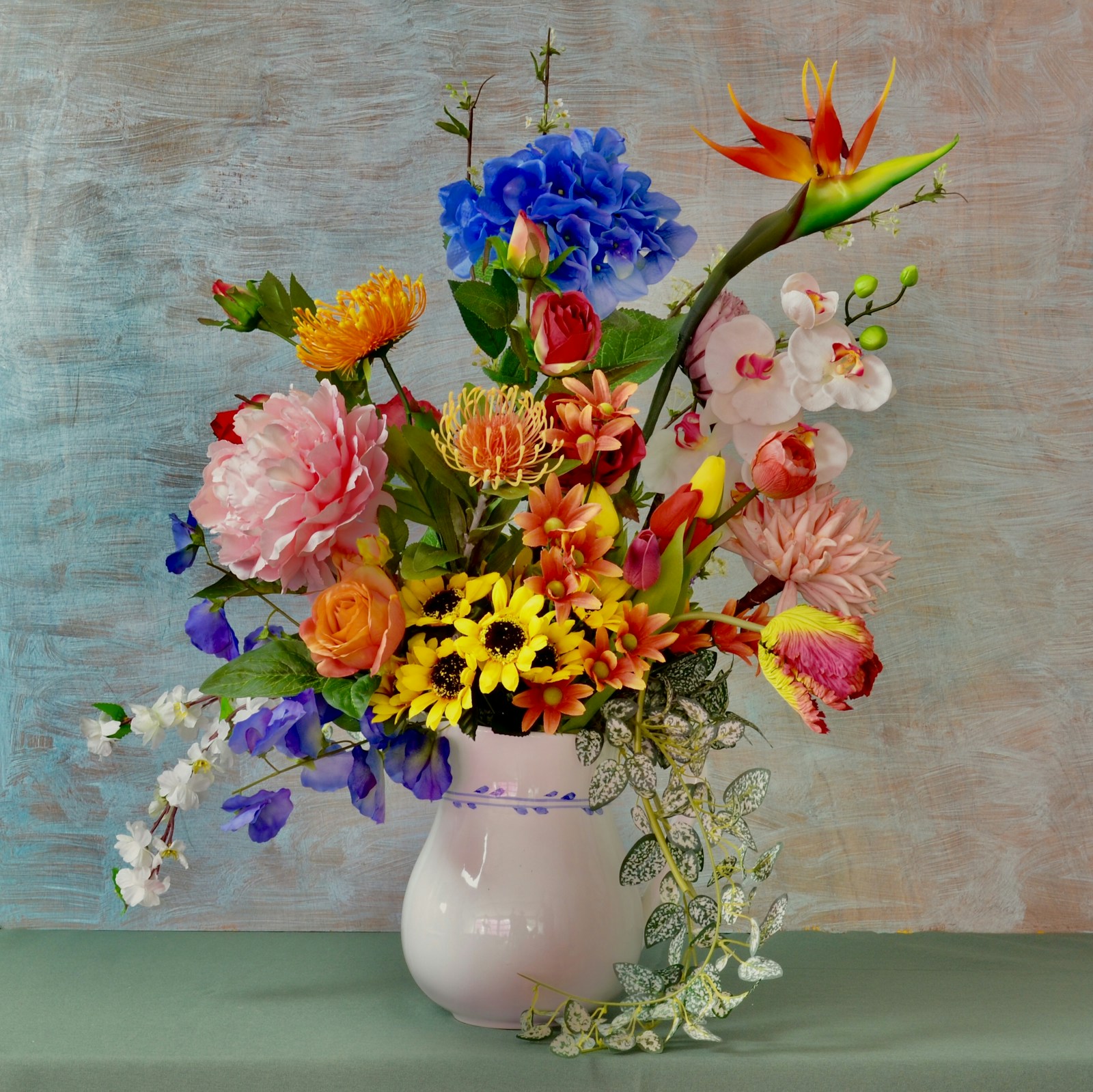
Still life photography gives you something useful: time to experiment. The subject can stay in place while you change the background, move the light or adjust the composition. A few flowers and a simple surface are enough to start.
Choose a colour relationship
Begin with two colours rather than a whole palette. They might sit close together for a quiet picture, or contrast for a more energetic one. Look at the background as carefully as the subject. It can support the colours, soften them or pull attention away.
Leave room around the subject
Empty space is an active part of the composition. Place the arrangement to one side, then try it in the centre. Compare how each version feels. A little breathing room can make a busy collection of shapes easier to read.
Bring texture into the conversation
Petals, stems, paper and a painted wall all respond differently to light. A light source from the side can reveal those differences. Move it gradually and watch where the shadows fall. The most useful position is the one that gives the shapes definition without distracting from the arrangement.
Change one thing at a time
Make a frame, change one element and make another. Turn a flower, swap the background or lower the camera. Keeping the changes small makes it easier to understand what improved the picture. Save a few versions together: the process can be as instructive as the final photograph.
THE CONVERSATION
Join the conversation.
Share a thought, ask a question or tell us what caught your eye.